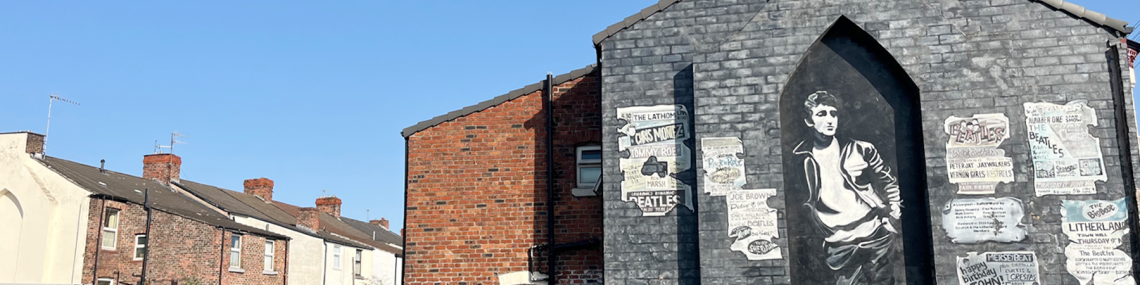
There’s something easy to overlook about Litherland Town Hall. Sitting on Hatton Hill Road, now operating as a health centre, it doesn’t immediately suggest anything remarkable. It’s practical, local, part of the everyday. But on 27 December 1960, it held something that would ripple far beyond Litherland, beyond Liverpool, and eventually far beyond Britain.
The night itself wasn’t meant to be historic. Just a post-Boxing Day dance, organised by promoter Brian Kelly, the kind of event that filled the in-between days of winter. The band on the bill had just returned from Hamburg, still relatively unknown in north Liverpool and, to many in the audience, not even recognisably local. Advertised as “Direct from Hamburg!”, they arrived with an edge that felt unfamiliar. The Beatles didn’t look like the other groups people were used to. Leather jackets instead of tidy suits, hair falling forward, a sound that felt louder, faster, less contained. Hamburg hadn’t polished them; it had sharpened them.
From the opening number, Little Richard’s “Long Tall Sally”, something shifted. This was supposed to be a dance, but people stopped dancing. Instead, they moved forward, drawn towards the stage in a way that wasn’t typical for these nights. There’s a sense, in every account that survives, that the atmosphere tipped almost instantly, from casual to charged. Pete Best later described the crowd surging forward, not to dance but to watch, to scream, to be part of something that felt new. It’s a small detail, but an important one. That change in behaviour, that urgency to be closer, feels like the beginning of something recognisable to modern crowds at concerts.
Looking back, John Lennon framed it as the moment they realised their own potential. Up until Hamburg, they had thought they were decent, nothing more. But that night in Litherland, hearing the reaction, seeing it unfold in real time, something clicked. They weren’t just another band on a local circuit. They were different, and for the first time, they could feel it.
What’s striking, though, is how unpolished parts of it still were. This wasn’t a perfectly executed breakthrough. Paul McCartney later recalled attempting a spoken section from Elvis’s “Are You Lonesome Tonight?” mid-performance, only to glance over and see the rest of the band laughing. It didn’t last beyond that night. In an interview with Uncut (January 2021), he reflected: “It’s funny, the memories that come into your head… I glanced at the rest of the band and they were peeing themselves. That was the last time I did that number! I think we were advertised in the Liverpool Echo as ‘Direct from Hamburg!’ – so the kids in the audience thought we were Germans… They were quite surprised when we started talking Liverpool English.”
That feeling of reinvention, of becoming something new in Hamburg before bringing it home to Liverpool, is still fascinating people over sixty years later. In fact, it’s now being dramatised in a major new television series. Hamburg Days, an upcoming six-part drama filmed across Hamburg, Munich and Liverpool, explores those formative early years when the band were still rough around the edges, playing smoke-filled clubs in Hamburg’s St. Pauli district long before worldwide fame arrived. The series focuses not only on the band themselves but on the influence of German artists Astrid Kirchherr and Klaus Voormann, whose friendship helped shape the image and identity of The Beatles during that period.
The cast includes Liverpudlian actors Ellis Murphy as Paul McCartney and Patrick Gilmore as Pete Best, alongside Rhys Mannion as John Lennon, Harvey Brett as George Harrison and Louis Landau as Stu Sutcliffe. Produced by W&B Television and Turbine Studios, the series has already begun filming in Liverpool and will air on BBC iPlayer and BBC One. It’s another reminder of how magnetic this era of Beatles history remains, not just because of what they eventually became, but because of how close it all still feels to ordinary places like Litherland.
The Beatles would play the venue many more times after that night, but the first performance is the one that stayed lodged in Liverpool’s memory. Not because anyone walked in expecting history, but because history has a habit of arriving quietly at first. Sometimes it begins in a grand theatre or stadium. And sometimes it begins in a crowded hall in Litherland, with people pushing towards a stage because, somewhere in the noise and chaos, they could already sense that something had changed.
As it happens, this story also arrives on Global Beatles Day, celebrated each year on 25 June. The date commemorates the band’s performance of All You Need Is Love during the first live global satellite broadcast in 1967, watched by an estimated 400 million people around the world.
The Beatles will release a colourised version of their BBC Our World performance of “All You Need Is Love” for free on YouTube at 5pm today – see below: