The formation of Sefton was part of a wider reorganisation of local government in England, which was carried out by the Local Government Act 1972. The Act was one of the most significant Acts of parliament to be passed by the Heath government of 1970-1974.
The Act abolished the old county councils and county boroughs, and it replaced them with new metropolitan counties and metropolitan districts. It was designed to create a more efficient and effective system of local government.
The formation of Sefton was a controversial decision. Some people argued that it was a mistake to merge the two county boroughs of Bootle and Southport, as they had very different histories and cultures. Others argued that the new borough would be too large and unwieldy.
However, the government of the day was determined to push ahead with the reorganisation, and Sefton was created on 1 April 1974.
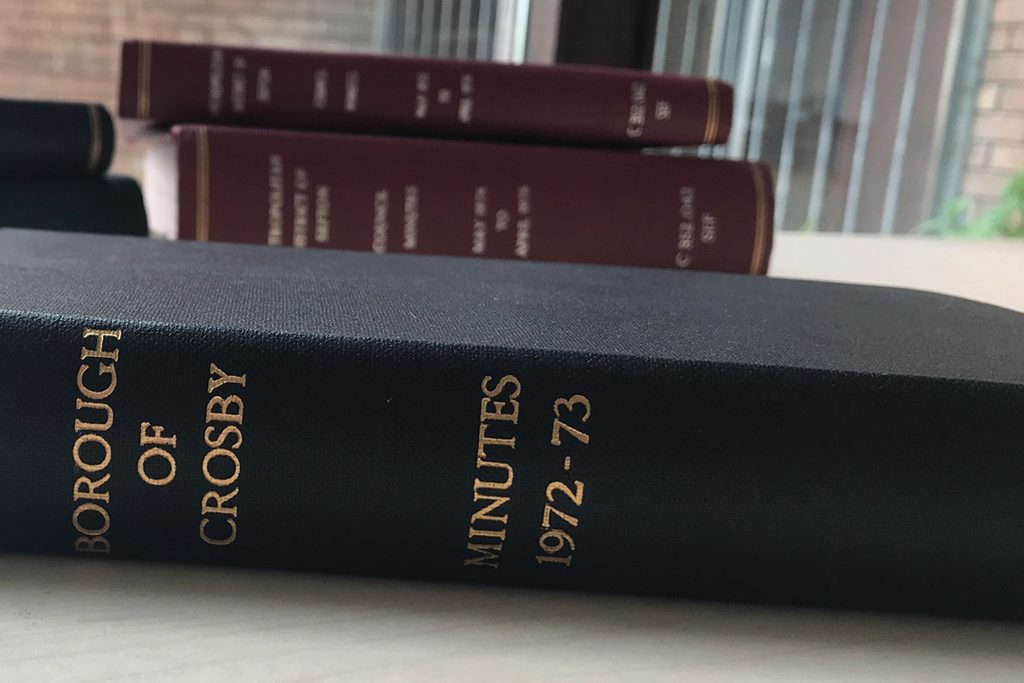
Council records from the time provide an interesting insight into how our borough got its name.
Borough of Crosby Council minutes of the Parliamentary Committee, from 6 September 1972, state that the Provisional Joint Committee had recommended that each constituent authority of District 11a (the newly designated borough) should recommend a name for the new district.
A list of suggested names sent to a competition held by local newspapers was submitted.
While the Borough of Crosby recommended the now familiar name of Sefton, some of the suggestions by other authorities are less familiar – including the almost futuristic sounding ‘Westport’ suggested by Bootle and the river related ‘Altborough’ suggested by Formby.
Southport had the least original suggestion of ‘Southport’ (or S.W. Lancs) and Litherland had yet to make a suggestion.
On 7 March 1973, the Parliamentary Committee reported that the Secretary of State for the Environment had made an Order under which the name of Metropolitan District 11a would be “Sefton”.
The name Sefton (after the village of Sefton, near Maghull) acknowledged the areas strong links with the Earl of Sefton and also a Sefton Rural District Council (covering some of the villages in the district that existed from 1894 to 1932).
For more on Sefton’s fascinating history visit: www.sefton.gov.uk/libraries